
Marina City Directory Collections Today
Marina's historical directory trail is real, but the research does not verify a standalone publisher and year run for every Marina address. The confirmed repositories are regional and distributed. MCFL has a large local-history digital archive and a physical archive in Marina. The Monterey Public Library California History Room supplies regional methodology and catalog access. Seaside adds newspaper microfilm and obituary research. The table keeps documented Marina scope separate from an unverified Marina volume list.
| Collection | Documented span or scope | Where held | Access |
|---|---|---|---|
| MCFL Local History Digital Archive | Chiefly 1890s-1970s; more than 2,000 Marina-area images and documents | MCFL ContentDM | Online browse and keyword search for Marina material |
| MCFL physical local-history archive | Historical Marina photographs, pamphlets, papers, and maps | 188 Seaside Circle, Marina | Appointment through Marina-area MCFL archive staff |
| Californiana reference collection | About 3,000 noncirculating books | Prunedale | Appointment; reference use |
| Monterey city and county directories | Exact Marina-inclusive publisher and year runs not verified | Monterey Public Library California History Room | Marina coverage requires a catalog and onsite holdings check |
| Herald and Salinas Californian microfilm | Marina-area newspaper coverage varies by reel and title | Seaside Branch | Onsite Marina obituary search is $5 per name |
| Federal census schedules | Public schedules through 1950 under the 72-year rule | NARA, FamilySearch, and library databases | Marina name, address, and enumeration research |
A catalog label does not guarantee that a volume uses modern Marina boundaries. For a Marina collection check, ask whether the contents include Marina, Fort Ord, the Monterey Peninsula, or another historical place label. Do not turn a regional title into a verified Marina publisher run until a Marina librarian confirms the volume, coverage statement, and page format.
Marina Before Incorporation in City Directories
Marina's chronology explains why a collection search can appear to lose the city. William Locke-Paddon purchased and subdivided 1,500 acres of Pueblo Tract No. 1 in 1912. The library began on April 24, 1916. Marina incorporated in 1975. A person living in the area before incorporation may appear in Monterey County, Monterey, Seaside, Castroville, or Fort Ord-oriented sources rather than in a municipal volume headed Marina.
Fort Ord-era telephone books, military records, Monterey Peninsula directories, newspapers, and federal schedules can be more useful than a narrow title search. The former base and the later California State University Monterey Bay layer also changed the institutions and place names attached to a Marina address. Search the name with county, military, university, and regional terms. Preserve the title page or catalog record that shows the geographic scope.
The 1912 subdivision, 1916 library, and 1975 incorporation are not merely local color. They mark changes in the likely custodian. Early land and deed evidence belongs in county systems. Military personnel material follows federal or military custody. Municipal planning and permit records become more relevant after incorporation and redevelopment. A Marina volume is best read against Marina's changing record geography.
The Marina Archive Beside the Branch
The Marina Branch is at 190 Seaside Circle and is the practical starting point for Marina staff referral, public computers, scanning, copying, faxing, printing, and current newspapers. Listed hours are Tuesday and Wednesday 11 a.m. to 7 p.m., Thursday 10 a.m. to 6 p.m., and Friday and Saturday 10 a.m. to 5 p.m. The branch phone is (831) 883-7507. The adjacent MCFL Administrative Office at 188 Seaside Circle holds historical photographs, pamphlets, papers, and maps by appointment.
Appointments for the physical archive go through (831) 883-7512 or KrajeskiJ@countyofmonterey.gov. The archive is physically in Marina, while the noncirculating Californiana books are at Prunedale and newspaper microfilm is at Seaside. A productive Marina research visit may therefore require several stops and an advance holdings request.
The Online Archive of California finding aid provides collection-level context for local-history material. It can explain the size and arrangement of an archival group without claiming that a particular Marina volume or person appears in it.
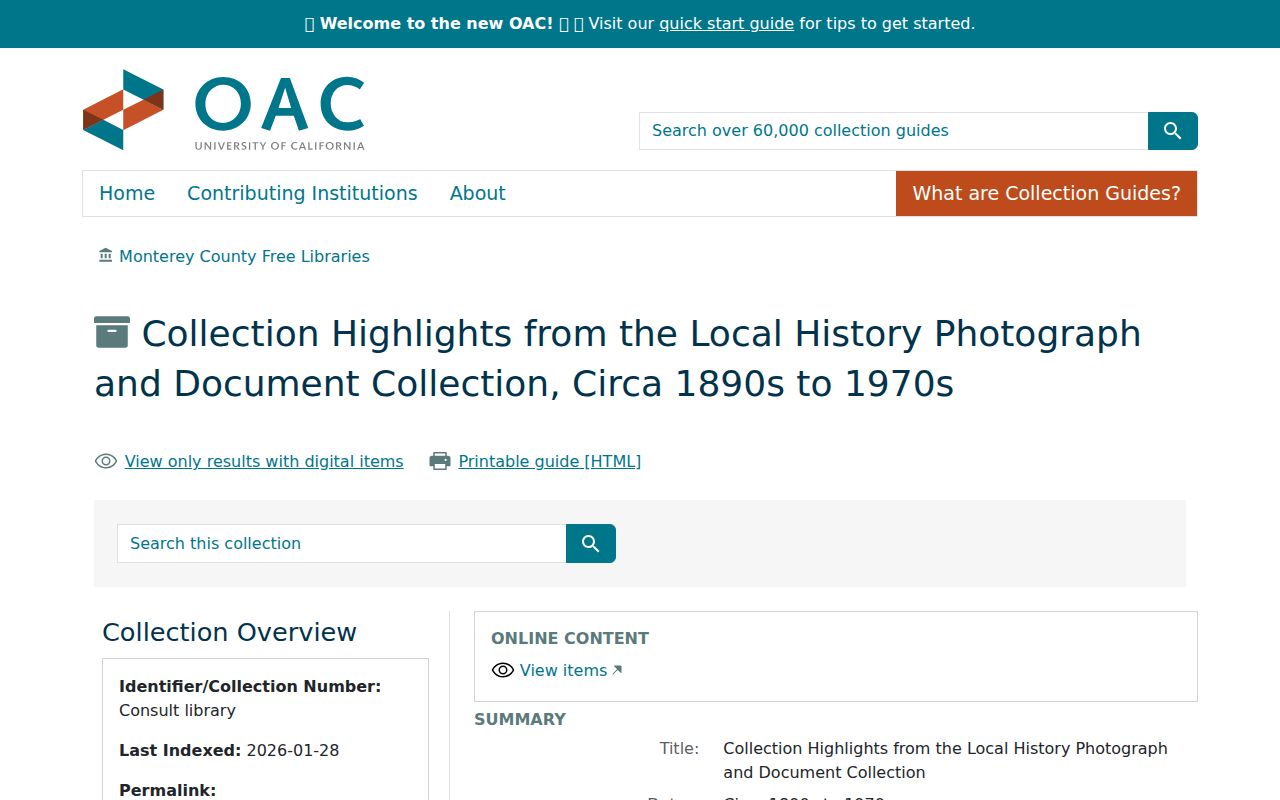
The finding-aid image belongs with the Marina archive route because a collection description is a planning tool. Read its scope, arrangement, and access notes before asking for a Marina scan or a name search. An archive description is not the same thing as an item-level index.
Note: MCFL's Marina archive, Prunedale Californiana books, and Seaside microfilm are separate holding sites, so confirm the destination before traveling.
Digital Marina Archive Clues in ContentDM
The MCFL ContentDM collection places more than 2,000 digitized images and documents online, with the broader local-history scope described as chiefly 1890s-1970s. Browse by subject, place, or collection context, and read the object description before treating an image as a Marina directory record. The Marina archive can surface photographs, maps, papers, and community documents that explain a Marina name or street without being a formal volume.
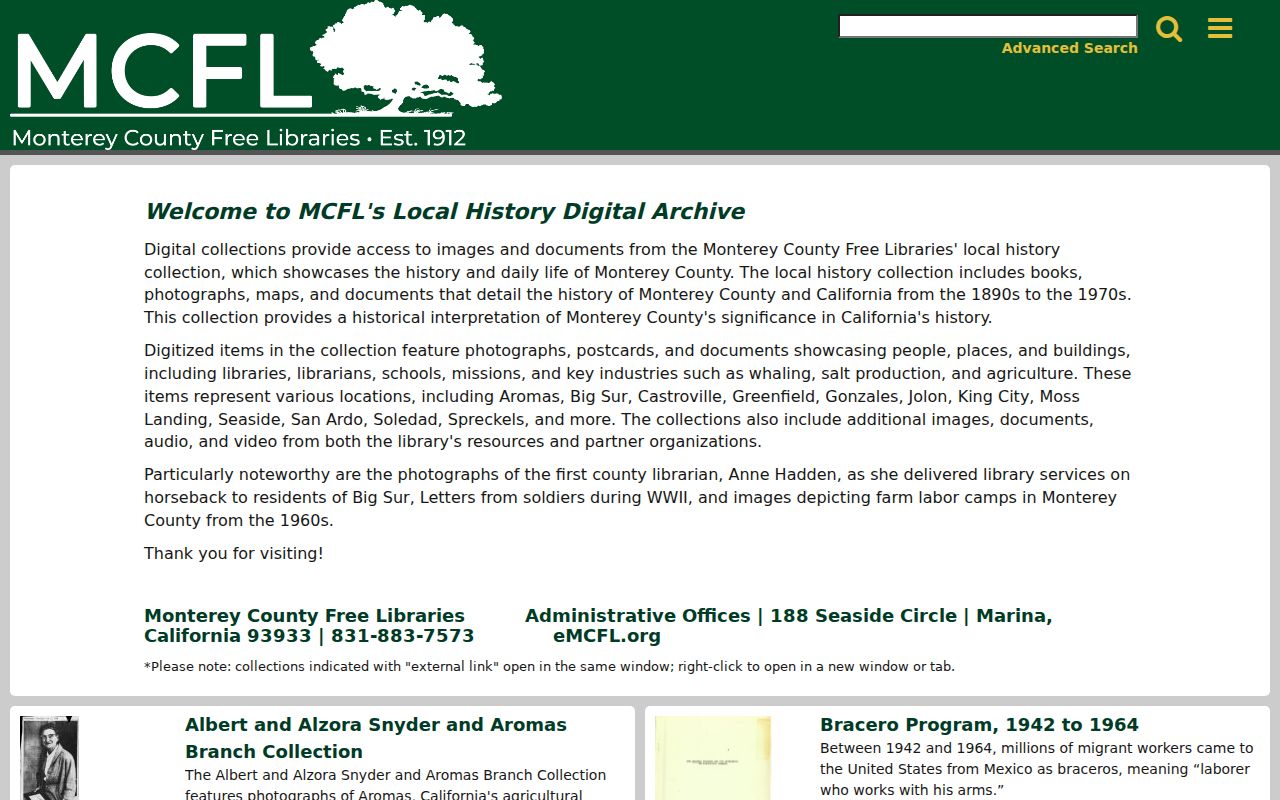
The Marina digital archive image shows why a search should keep both the object and its description. A scan may preserve a place name, community group, military connection, or newspaper-era clue. It still needs a date, geographic scope, and independent record before it can support a Marina household timeline.
The MCFL Local History page also routes researchers to the genealogy and family-history resources. Use the online collection for Marina discovery, then ask the local-history staff whether a physical directory, map, pamphlet, or newspaper reel fills the gap.
Reading a Marina City Directory Entry
A regional directory entry should be read field by field, not expanded from memory. For a Marina directory, first photograph or cite the title page, publication year, publisher, coverage statement, and abbreviation key. Then record the alphabetic entry and, if available, the matching reverse entry. Marina publisher conventions vary, and an abbreviation that is clear in one volume may mean something else in another.
| Name | Surname, given name or initial, and possible cross-reference. Compare Marina spelling and initials across years. |
|---|---|
| Spouse | Often printed in parentheses or beside the household name. Treat it as a Marina clue tied to that publication year. |
| Occupation | A historical field that can distinguish two same-named Marina entries and connect a household to a local institution. |
| Address | House number and street, sometimes with a residence or boarding marker. Confirm the Marina volume's key. |
| Owner or renter mark | Some Marina runs use a symbol or abbreviation. Do not assume every publisher marks tenure. |
| Widow or telephone note | A Marina notation or number can point to a family change or cross-reference, subject to the volume's privacy and coverage limits. |
- Criss-cross section
- The reverse half of a directory, arranged by street and number so a listed occupant can be found from an address.
- Householder index
- A name-oriented entry point for a household or principal resident. It may omit other members of the household.
- Abbreviation key
- The publisher's explanation of marks and short forms, usually near the front. Photograph it before reading entries.
- Listed occupant
- A person printed at a Marina address for the volume's publication cycle. The term does not prove present residence.
Marina Microfilm and Regional Directories
Seaside Branch holds microfilm of the Monterey County Herald and Salinas Californian and performs obituary searches for $5 per name. Give staff a full name, spelling variants, an approximate death date, a likely city, and relatives. For a Marina household, keep the newspaper title, date, page, and search result in the notes. An obituary can add maiden names, relatives, dates, and former communities, but it is not a certified civil record.
The Monterey Public Library California History Room's Your House Has a History guide offers a regional method for directories, maps, county great registers, census material, and archives. It distinguishes alphabetical use, which moves from person to address, from reverse or criss-cross use, which moves from address to listed occupant. The guide is valuable Marina methodology, not an item-level statement that every volume includes Marina.
MCFL's Marina archive, Prunedale Californiana collection, Seaside microfilm, and the Monterey History Room serve different purposes. A good collection search asks the right repository for the right layer: directory holdings for names and addresses, microfilm for notices, maps for place continuity, and county or federal records for land and household checks.
Verify Unconfirmed Marina Directory Year Runs
The research does not establish a verified Marina publisher, volume sequence, or sample person for a directory. That gap should stay visible. A catalog label such as “Monterey City and County Directories” is not enough to claim that a particular year includes Marina or Fort Ord. A researcher can turn the gap into a precise library request.
Ask MCFL archive staff and the Monterey Public Library California History Room to identify every city, county, telephone, or reverse directory whose geographic coverage includes Marina or Fort Ord. Request the title, publisher, volume year, call number, format, copy policy, alphabetical or reverse sections, coverage statement, and abbreviation page. Ask whether the volume is open shelf, microfilm, digitized, or available only by staff retrieval.
For a Marina appointment, contact the MCFL archive through (831) 883-7512 or KrajeskiJ@countyofmonterey.gov. For the History Room, use the library catalog and onsite research route. The answer should be recorded as a holdings citation. It should not be replaced with a familiar national publisher name or an invented run.
Shelf check. Until a librarian confirms the volume, describe the collection as regional Monterey city and county directories with Marina coverage unverified, not as a complete Marina run.
Note: No authoritative source inspected verifies a Marina-inclusive publisher and year run, so a librarian's holdings statement remains necessary.
Tracing a Marina Household Across Volumes
Use a Marina directory volume as a sequence of time-stamped clues. The strongest household trail compares the name entry, address entry, census schedule, deed or permit, and newspaper or probate evidence without letting one source stand in for another.
- Cite the title page, publisher, year, geographic scope, and abbreviation key before searching a name.
- Search a Marina surname, given name, initials, married or maiden forms, and regional labels that fit the era.
- Record a Marina address, spouse notation, occupation, owner or renter mark, telephone note, and any cross-reference exactly as printed.
- Flip to the reverse section, if present, and compare the street and number with the alphabetic entry.
- Pair a Marina directory near the 1940 or 1950 census with the corresponding enumeration record, then note differences in household members and address.
- Close the Marina trail with a deed, probate filing, obituary, newspaper notice, or library archive item that fits the same person and date.
A disappearance from a volume has several explanations. The person may have moved, died, changed a name, served elsewhere, been omitted, or fallen outside the volume's geographic coverage. Compare at least one later or earlier year and one independent source before choosing among them. When the question shifts to a current parcel, the Marina street address chain supplies the modern APN and land-record method.
Marina Directory Research Timeline
A short Marina timeline keeps volume research tied to local record history. It also prevents a modern city label from being pushed backward into a period when county, military, or regional names were more likely.
| Period | Local context | Research consequence |
|---|---|---|
| 1912 | Locke-Paddon subdivides Pueblo Tract No. 1 | Search county land, subdivision, and regional place names before assuming a municipal Marina title. |
| 1916 | Marina library service begins | Marina library and newspaper routes become part of the local historical trail. |
| 1975 | Marina incorporates | Marina municipal planning and city records become a newer custody layer. |
| Fort Ord and CSUMB eras | Military land, redevelopment, and university records overlap | Search federal, county, city, and university collections with the period's Marina place terms. |
| 1890s-1970s archive scope | MCFL digital local-history material spans a broad regional past | Use ContentDM for discovery, then confirm whether an item is a directory, map, paper, or photograph. |
What a Marina Directory Entry Proves
A Marina city directory entry can establish that a publisher printed a person, a Marina address, and perhaps a spouse, occupation, telephone, or ownership mark in a defined publication cycle. It cannot establish that every person at the address was listed, that the entry is current, or that two same-named entries are one person. A missing entry is not proof of absence. The title page, coverage statement, and abbreviation key are part of the evidence.
Pair the directory with a 1940 or 1950 census when the dates align. A census enumerates a household on an enumeration date. A deed records a legal transfer. A permit dates a project and may name an applicant. An obituary connects family information supplied to a publication. Each source has a different proof scale. The strongest Marina collection research reports the record date, the exact source, the geographic uncertainty, and the next custodian to check.
Historical research is most useful when it preserves gaps instead of filling them with a guessed publisher, person, or year. A confirmed Marina catalog citation, a photographed entry, and an independent land or family record are enough to build a careful household timeline without turning a regional collection into a complete residents directory.