
Tracing a Marina Street by Address
A Marina street directory search begins with Marina land, not a name. Monterey County's assessor web interface does not accept a public owner-name or street-address query, so a Marina street must be mapped to a parcel before the roll can be opened. The county GIS Parcel Report App supplies that spatial bridge. Once an APN is saved, the assessor can return parcel facts, the recorder can be searched by parties, and Marina permits or planning files can add a dated project trail. A deed may show title transfer, while a directory or census may show a household snapshot. Those are related records, not interchangeable proof.
Walk the Marina address in a fixed order. Keep the original address, postal city, unit or lot, map view, APN, and record date in the research notes. Do not assume that nearby house numbers represent consecutive parcels, or that a Marina mailing line proves City of Marina jurisdiction.
- Normalize the Marina address, including direction, street suffix, unit, former spelling, and the date of the question.
- Open the Monterey County GIS applications page, launch the Parcel Report App, and click the mapped polygon.
- Save the Marina APN, situs address, subdivision or lot clues, and any map-page reference shown by the parcel result.
- Run the assessor's Fee Parcel Number, Assessment Number, or APN path that matches the result, while noting that owner-name and street-address searches are unavailable online.
- Search the recorder's current or historical grantor-grantee index, then compare the legal description and recording date before linking a party to the parcel.
- Check Marina Building and Planning records for a dated project, then use a verified Marina regional reverse directory or census schedule only for the era it documents.
The map-to-APN sequence is the heart of responsible Marina address research. It can identify an assessed parcel and a dated owner or applicant. It cannot reveal every person who uses a building, and it cannot turn a single record into a claim about current residence. Historical shelf work can continue through the Marina city directory collections when the question shifts from a current parcel to a former household.
Marina Assessor Records Begin With APN
The Monterey County Assessor Property Inquiry has three documented public key paths for a Marina parcel. The labels are not a promise of a Marina name search. They identify the number needed to retrieve an existing parcel or notice record.
| Field | Type | Required or use | What it returns or limits |
|---|---|---|---|
| Marina Fee Parcel Number | Text | Required in roll mode | Public web search key. No owner-name or street-address search is offered for Marina parcels. |
| Assessment Number | Text | Alternative path | Searches Property Value Notice data. |
| APN | Text | Required in map-page mode | Retrieves a Marina property address, values, exemptions, and assessor map page. |
The Marina Property Value Notice path can show ownership, parcel status, tax-rate area, assessed values, exemptions, and parcel characteristics. The APN map-page path can show Marina property address, values, exemptions, and the map page. Characteristics are maintained for assessment and are not promised to be continuously updated. The assessor result is a parcel record, not an all-occupant roster.
The static GIS page confirms the Marina Parcel Report App and its map and parcel-information purpose. It does not publish every live toolbar label, selectable layer, buffer control, result-popup field, or export behavior. Describe only the verified Marina map-browse sequence until the app itself has been inspected. A map click can give the APN; it cannot authorize a bulk household list.
Note: If a Marina address search stops at the assessor gateway, keep the address and use the map or recorder index as the next evidence bridge.
Marina Street Records, Source by Source
Address-keyed records answer different questions along the same Marina street. The Marina coverage map below keeps title, assessment, planning, postal, civic, and historical evidence separate. Access can be online, counter-based, request-based, or restricted by purpose.
| Record set | Keeper | What it shows | Access |
|---|---|---|---|
| Marina parcel report and map | Monterey County GIS | APN, boundaries, nearby parcels, map context | Online visual browse and open-data routes; static controls are limited |
| Marina assessment roll | Monterey County Assessor | Assessed owner, situs, values, exemptions, parcel facts | APN or assessment key online; counter and written request fallback |
| Marina recorded deeds and liens | Assessor-County Clerk-Recorder | Grantor, grantee, date, document type, legal transfer | 1850-1977 and 1978-present indexes; counter, order, and copy channels |
| Building permit history | Marina Building Division | Marina address, APN, applicant or owner fields, project and status | CitizenServe account, counter, phone, or narrow public-record request |
| Planning and zoning | Marina Community Development | Project applicant, parcel, conditions, hearings, zoning context | CitizenServe, agenda packets, Zoning Counter, email, phone, or request |
| Voter registration file | Monterey County Elections | Restricted civic data for an approved statutory purpose | Application and review only; not an ordinary street browse |
| Marina reverse directory or census | Regional libraries and federal repositories | Dated listed occupant or enumerated household | Catalog, onsite, microfilm, or genealogy access; exact Marina run varies |
The Marina parcel number ties the assessor and GIS layers to the recorder's legal description. A Marina project address ties a permit to a place and date. A USPS delivery address helps route mail, while a city boundary decides municipal custody. Historical sources may use a different place name. Read the Marina address chain as distinct links, not one large record.
Marina Address Terms Behind a Street Directory
Marina address language can create a false match when it is treated as one key. A Marina record may contain a physical location, a tax-mailing destination, a legal description, and a postal label that all differ. Define the term before comparing two Marina records.
- Marina APN and parcel
- An APN is the assessor's parcel number. The parcel is the mapped unit of Marina land that the number identifies. It is a land key, not a household count.
- Marina situs address
- The physical-location label attached to the assessed parcel. It helps place Marina land and may not describe who occupies it.
- Owner mailing address
- The destination for tax or assessment correspondence. It can be a different city, a post-office box, a trustee address, or another contact point.
- Marina legal description and plat
- The legal description defines the land conveyed. A recorded plat or assessor map can connect lot, block, subdivision, and boundary clues when Marina street text changes.
- Marina USPS address
- The deliverable mailing label. USPS controls delivery standards; a postal city does not certify a Marina municipal boundary or record custodian.
- Marina criss-cross directory
- A reverse directory arranged by street and number. It can show a listed occupant during a publication cycle when the Marina volume includes the area.
For an edge Marina address, preserve both the USPS result and the county GIS view. For a Marina deed, preserve the legal description and recording reference. For a permit, preserve the APN and application date. Those controls prevent a mailing label or an old street spelling from being treated as proof that two records describe the same place.
Marina Permit Records Date a Property
Marina Building Services is a useful Marina address layer because a permit file can carry many parcel clues in one dated project. The Building Permits page describes the requirements route and points toward the fields that matter for a Marina parcel-based search.
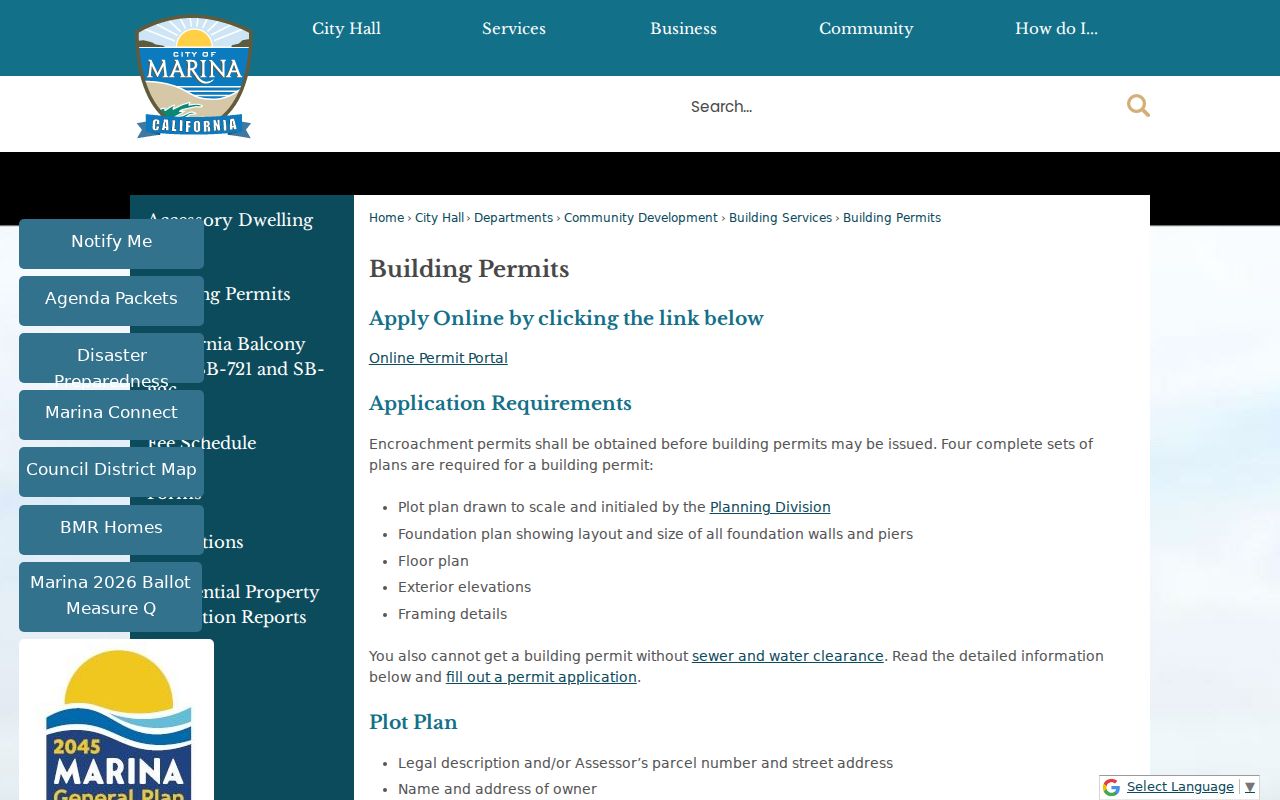
The permit source image reinforces the difference between a project record and a Marina street directory. A plan can name an owner or applicant, but the name is tied to that Marina application and date. It does not certify every current occupant or every person connected with the address.
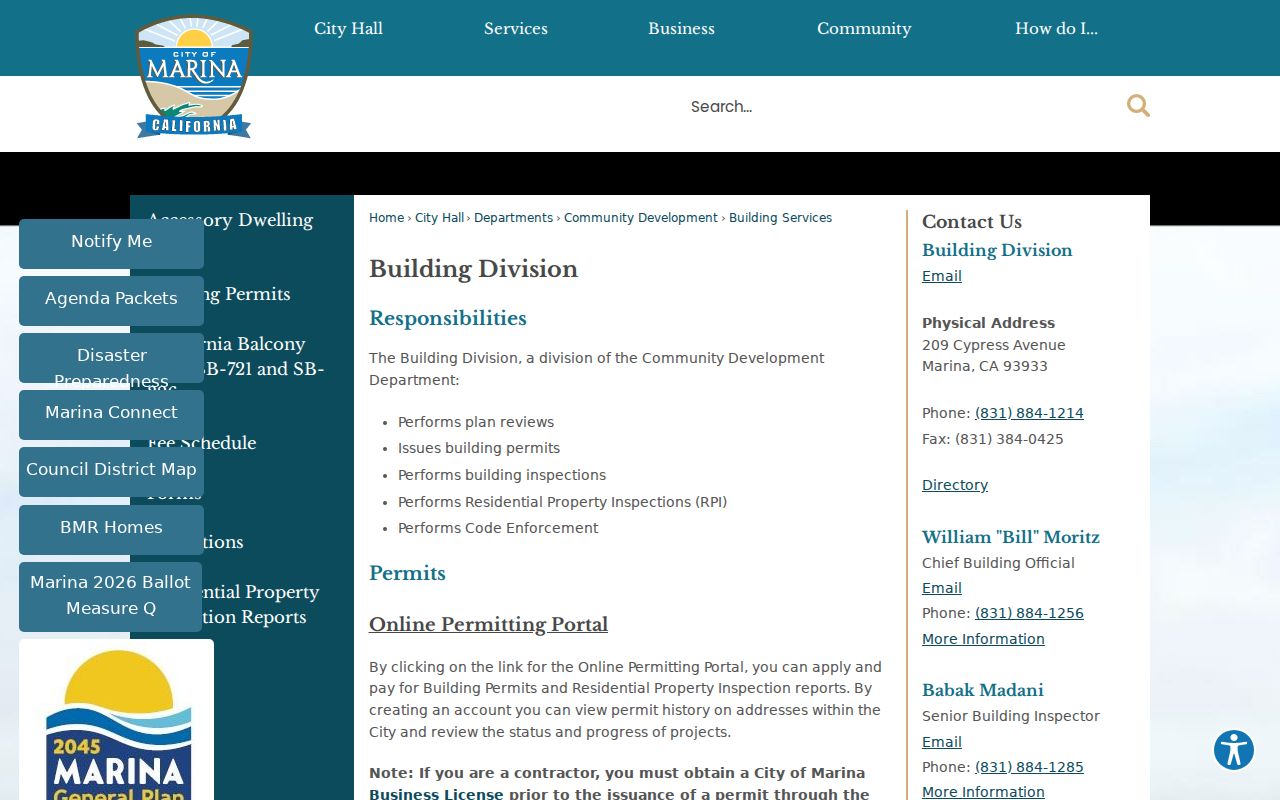
A free CitizenServe account lets a researcher view Marina permit history by address and project status or progress. The system also handles building-permit and Residential Property Inspection applications and online payment. When a portal result is unclear or an older file is not visible, use the Building Division counter or call (831) 884-1214 at 209 Cypress Avenue, Marina. An inspection appointment must be requested at least 24 hours ahead, with AM windows from 8 to 12 and PM windows from 1 to 4, Monday through Friday.
The Marina Building Services page supplies the account and service context for the address history route.
Marina plans can identify legal description or APN, street address, owner name and address, lot dimensions, buildings, property lines, roads, easements, grade, and drainage. These details are strong parcel anchors. They remain dated project evidence, not a statement about who lives at the Marina site now.
Marina Planning Records Add Jurisdiction Context
Planning records can explain why a Marina address appears in one municipal system and not another. Marina Planning offers a CitizenServe development-project portal, zoning lookup, an in-person Zoning Counter, planning@cityofmarina.org, and (831) 884-1220. Community Development is open Monday through Friday from 8 a.m. to 5 p.m. Use these Marina channels for zoning, project, hearing, and parcel context rather than asking for a current resident list.
The Marina Community Development page is the direct route for department contacts and project guidance.
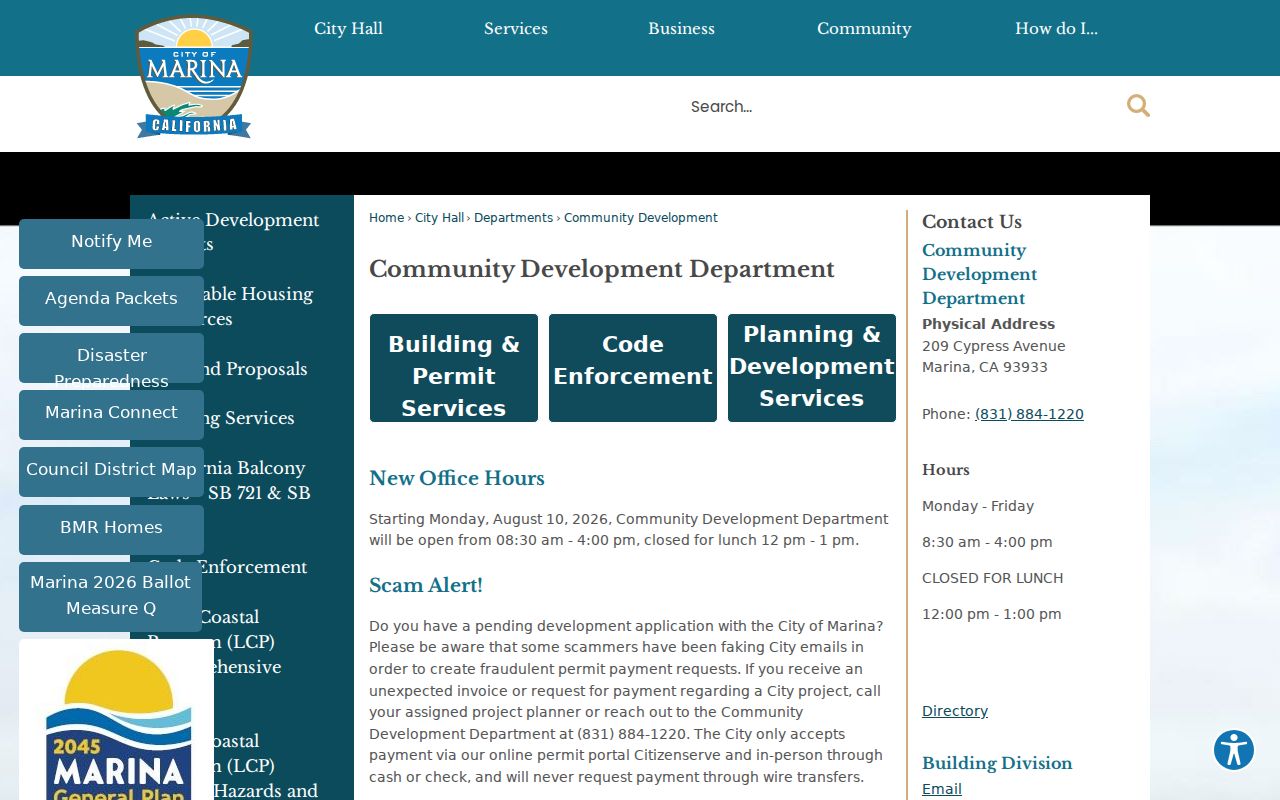
Marina Community Development records can connect a project applicant, parcel, hearing, condition, or dated plan. Agenda packets may preserve the same link when a portal is difficult to search. If an identifiable older permit or correspondence is not online, a narrow California Public Records Act request can ask for existing Marina entries by address or APN, date range, permit type, and fields such as permit number, status, inspection history, or final date.
NextRequest is Marina's newer request and tracking route for city and police records. It does not replace the county recorder, assessor, elections office, court, or emergency communications custodian. A Marina address search should send each request to the office that holds the record.
Marina Deed Records Follow the Parcel Chain
The Monterey County recorder's On-line Document Access gateway divides Marina official records into a current 1978-present index and a historical 1850-1977 index. The same gateway also covers fictitious business names and CEQA records in the current index. Search a known person as both grantor and grantee, then save the recording date, document type, number, and legal-description reference. Grantor means the party conveying an interest. Grantee means the party receiving it. A deed shows a transfer of title or an interest in land. It does not by itself show residence.
For a Marina street search, use the APN and legal description to control the chain. Search the current assessed owner for an acquisition deed, read the seller, and search that seller as an earlier grantee. Trust and entity names matter. Marina street text alone can fail when a lot has a different legal label or when a parcel was reconfigured. Plats and assessor maps help bridge the gap.
The online index is a finding aid. For recorded images, book and page material, older references, ordinary copies, or certified copies, use the Monterey County Assessor-County Clerk-Recorder counter or its order route. Call through the official recorder page before traveling to confirm the Marina location, hours, payment, and whether a volume is onsite. A narrow CPRA request can ask for an existing index specification or retention record, but CPRA does not require the county to create a title abstract for a whole street.
Note: A Marina deed party is evidence of a recorded legal role, not proof that the party occupied the property on the recording date.
Walking Adjacent Marina Street APNs
A Marina block search needs a rule before the map is opened. “Adjacent” can mean a parcel sharing a boundary, a parcel facing the target across a street, or every parcel within a stated radius. Condominiums, common areas, rights-of-way, large lots, and easements can make visual closeness different from legal adjacency. The GIS map is a way to select Marina parcels for separate research, not a ready-made list of neighbors.
- Choose and write down the Marina boundary rule: shared line, opposite frontage, or a measured radius.
- Click the target Marina parcel in GIS and record its APN, then pan and click each selected nearby polygon.
- Run each Marina APN through the assessor separately, keeping situs, mailing, owner, and exemption fields distinct.
- Use the recorder, permits, planning files, or recorded declarations only when a dated land or project question calls for them.
- Label gaps instead of inferring a household from a parcel, a license, a tax mailing address, or a public association contact.
The GIS static page confirms Marina map, search, and parcel-information functions but does not verify a named buffer tool, a specific adjacent-parcel control, or a complete export schema. A safe Marina parcel workflow therefore teaches the repeat-APN method and leaves the live interface labels to the official app.
Marina Street Geography: 93933 vs City Limits
Marina's verified principal USPS ZIP is 93933. It serves ordinary street delivery and PO boxes associated with the Marina postal area. USPS city and state lookup is the authority for a deliverable Marina mailing ZIP. ZIP geography is a mail route, not a city-boundary certificate. Preserve the USPS result when an edge Marina address matters, then use county GIS and the city zoning map to test jurisdiction.
Former Fort Ord makes the Marina distinction especially important. A mailing line can say Marina while the land record, former federal history, CSUMB connection, or nearby Seaside context points to a different custodian. A city parcel can also have an owner mailing address outside Marina. Ask two separate questions: where can mail be delivered, and which agency has custody of the Marina land-use or public record?
No verified blanket street-renumbering event was found for Marina. Do not invent one to explain an old Marina address mismatch. Instead compare a current situs address with APN, lot and block, subdivision or plat, assessor map page, recorded deed, and a dated directory. That Marina parcel-first control is stronger than assuming a street name or number stayed fixed from the Locke-Paddon subdivision through Fort Ord redevelopment and later CSUMB growth.
Historical Marina Street Directory Snapshots
Older reverse or criss-cross volumes can put a listed adult at a street address during one publication cycle. They are useful for previous-household research, but the exact Marina-inclusive publisher and year run has not been verified. Monterey County Free Libraries, the Monterey Public Library California History Room, and the Seaside Branch are the right access points to confirm title, publisher, geographic coverage, alphabetical section, reverse section, call number, and copy policy.
The Seaside Branch holds Monterey County Herald and Salinas Californian microfilm and performs obituary searches for $5 per name. The Marina Branch and the MCFL archive add local photographs, maps, papers, and staff referral. A newspaper, directory, or census record should be cited with its publication or enumeration date. An absence can mean a missing volume, an omitted name, a move, a name change, military service, or a coverage limit.
When a Marina street-level question turns into a family-history question, use the historical collections as a dated layer rather than rebuilding a current address chain. A directory entry can support a household hypothesis. Deeds, probate, and an independent census or newspaper source can test it.
What the Marina Street Directory Cannot Show
No public Marina street directory reveals every occupant, guest, family member, utility customer, minor, or person protected by a confidential-address program. California's voter file is not an open street list. A self-status lookup is for the requester, while a fuller file needs an approved election, scholarly, journalistic, political, or governmental purpose and a county application. DMV address information is restricted by the federal Driver's Privacy Protection Act. Safe at Home and protected-official rules can suppress addresses from government records.
Marina permits, deeds, assessor data, court indexes, licenses, and historic directories each show a dated role. They do not combine into a guaranteed statement that a person currently lives at a Marina address. A Marina matching name needs time, place, role, and a stable key before it can be treated as the same person. When the evidence stops, the accurate answer is a documented gap.
Lawful use. Use Marina street and address records for personal, genealogical, estate, civic, or careful parcel research. California Penal Code section 646.9, Code of Civil Procedure section 527.6, Elections Code section 18109, and federal privacy rules set real limits. Do not stalk, harass, intimidate, dox, or publish a protected address.