
Finding the Marina Residents Directory
Marina has no single government residents directory. The useful Marina record chain depends on the clue in hand. A street address points first to the county GIS map and an APN, then to a parcel roll, city permit file, and recorded deed. A name can lead to a court case, business filing, professional license, or a grantor/grantee index. A historical question belongs with Monterey County Free Libraries, the Monterey Public Library California History Room, newspapers, census schedules, and old directories. The goal is not to turn one hit into a claim about a household. Each source answers a narrower question, on a date, for a person or parcel in a defined role.
Start with the most stable Marina key available. A full address can be normalized for spelling, direction, unit, and postal city. A name should be searched with initials, alternate spellings, entity names, and a time range. A past household needs a directory, census, deed, obituary, or probate clue rather than a current ownership assumption. The county assessor identifies assessment facts after an APN search, but it does not offer the owner-name or street-address mode found on many other county sites. California voter information is restricted by purpose, so it is not the default path for a personal directory search in Marina.
- Write down every Marina version of the name or address, including a former place name and a likely date range.
- Check whether the mailing city is municipal Marina or only a Marina postal label connected with nearby land.
- Use the Monterey County GIS Parcel Report App to locate the Marina parcel and save the APN, situs, and legal-description clues.
- Use the Marina APN with the assessor, then compare dated permit or planning records without calling an applicant a current resident.
- Search the Monterey County recorder indexes by grantor and grantee, using the Marina deed legal description to control same-name matches.
- Use the Monterey Superior Court portal, official business and license searches, or an approved Marina elections request when the research question fits.
- Corroborate a Marina result with a second custodian, preserve the record date, and stop when the file is sealed, protected, or outside the approved access purpose.
The address-heavy path follows the Marina street directory method of map, APN, roll, deed, and permit. A historical Marina household belongs with the shelves and digital collections described in the Marina city directory discussion. These paths complement one another, but neither creates a complete list of everyone who lives in a Marina neighborhood.
Marina Resident Records Offices
Five records doors matter most for a Marina search. Marina city departments hold municipal permits, planning files, agendas, and police records. Monterey County keeps the property, title, vital, fictitious-business-name, and election records that a city office does not. Superior Court keeps case, probate, family, and divorce files. Libraries and archives preserve older community evidence. The custodian matters as much as the name: Marina's public-records routing notice says that city police records, county dispatch, county vital records, county property records, and court files are separate systems.
Monterey County Assessor-County Clerk-Recorder
Marina-area countywide property, title, vital, FBN, and CEQA records
Monterey County, California, including Marina
Official-record indexes: 1850-present
Monterey County Assessor
Marina APN maps, assessment values, exemptions, and parcel facts
Marina public web search is parcel-keyed
Property-tax-roll help: (831) 755-5035
Monterey County Elections
Marina election-file requests route through 1441 Schilling Place, North Building
Salinas, CA 93901, for Monterey County and Marina matters
(831) 796-1499
For a written Marina request, describe an existing record, date range, address, APN, case number, or document number. A request asking City Hall to name everyone who lives at an address asks an office to create an answer it may not hold. A narrow request to the correct Marina custodian is more useful and more likely to preserve lawful, segregable material.
The Marina Parcel Number Detour
Monterey County's Marina assessor portal changes the usual property-search workflow. The public web interface does not search by owner name or street address. The county cites the protections associated with former Government Code section 6254.21, now recodified within the California Public Records Act, and uses parcel-based keys instead. That restriction is not a dead end. The Monterey County GIS applications page points to the Parcel Report App, where a researcher can locate a Marina polygon, read the APN, and then use the assessor's documented query modes.
The practical Marina bridge is address to map to APN to assessor to recorder. The assessor can return ownership-related roll facts, situs address, values, exemptions, parcel characteristics, and an assessor map page. The recorder's index is name-oriented, so a recorded grantor or grantee can also become the bridge back to a Marina parcel. A permit plan may supply an APN and legal description. Each bridge should be saved with the date and source, because a tax roll, permit, and deed describe different evidence.
Do not treat the Marina assessor result as a live household roster. Ownership can sit in a trust or entity. A mailing address can belong to a trustee, accountant, or prior owner. Parcel characteristics are maintained for assessment and are not promised to be continuously updated. The online roll is a research key, not a claim that a named person currently occupies the Marina property.
Note: A Marina recorder party search can supply the APN that the assessor's public web search will not find from a familiar street address.
Current Marina Resident Directory Sources
A current Marina source set is best understood as dated evidence. The sources below can connect a Marina person, parcel, project, or civic record with a Marina place and date, but none covers every person. The strongest result states what the record shows and what it cannot show.
| Source | Evidence | Keeper | Access and limit |
|---|---|---|---|
| Marina GIS parcel and assessor roll | APN, situs, assessed owner, values, exemptions | Monterey County | Map first, then Marina parcel key; no public name/address browse |
| Marina recorded-document index | Grantor, grantee, document date, type, legal reference | Assessor-County Clerk-Recorder | 1850-1977 and 1978-present indexes; Marina images or copies vary |
| Marina Superior Court portal | Case number, case name, status, filing date, type | Monterey Superior Court | General coverage from 2008; criminal electronic data from November 1992 |
| Marina permits and planning | Dated applicant, owner, APN, project, address, status | Community Development | CitizenServe account, counter, or Marina request; not current occupancy proof |
| Marina voter status or approved file | Own status, or restricted civic fields for an approved purpose | California SOS / Monterey Elections | Not an open street list; Marina applications and safeguards apply |
| Marina library and archive collections | Past names, addresses, news, maps, and community context | MCFL and regional libraries | Branch, appointment, microfilm, and digital channels differ |
Property and recorded documents are the most direct route when the starting clue is a Marina address. Court, business, and license records are stronger when a Marina person or entity has a stable number. A Marina directory or census snapshot is useful for a past household, while a permit gives a project chronology. A search result becomes persuasive only when time, place, and role align across at least two independent sources.
Marina Assessor Search Fields
The Marina assessor interface has three documented public key paths for Marina parcels. They are easy to confuse because APN, fee parcel number, and assessment number may all appear in a property record, but they do different work. A fee parcel search reaches the public roll. An assessment-number search reaches Property Value Notice data. An APN search on the map-page path returns parcel facts tied to the Marina map.
| Marina Fee Parcel Number | Text field. Required in roll mode. Public web search key; the county does not offer owner-name or street-address search. |
|---|---|
| Marina Assessment Number | Text field. Alternative path for Property Value Notice data, including assessment-related facts. |
| Marina APN | Text field. Required in map-page mode. Retrieves property address, values, exemptions, and assessor map page. |
A Marina Property Value Notice result can show ownership, parcel status, tax-rate area, assessed land and improvement values, exemptions, and characteristics. The APN map-page result can show the property address, values, exemptions, and map page. The county warns that characteristics serve assessment work and are not continuously updated. Searchers should preserve the APN and map page, then use the recorder for title evidence instead of treating the Marina roll as a full resident list.
The county's web limit also explains why a Marina GIS walk matters. A map can connect a street to several APNs, but the static GIS documentation does not publish every live toolbar, layer, buffer, result-popup, or export control. Describe the Parcel Report App as a map and parcel-information tool, not as an unverified bulk people search.
Marina City Records and NextRequest
City records add a municipal layer to the Marina residents directory, especially when the question concerns a dated permit, planning case, agenda, code matter, or police report. Marina's services routing points to city departments and public-record channels. Building plans can contain a legal description, APN, street address, owner name and address, lot dimensions, structures, property lines, roads, easements, grade, and drainage. Those fields help anchor a parcel and project. They do not certify who occupies it.
The Marina city services route is summarized on the City of Marina services page. The linked source helps distinguish Marina city-held records from county property, vital, court, and dispatch records.
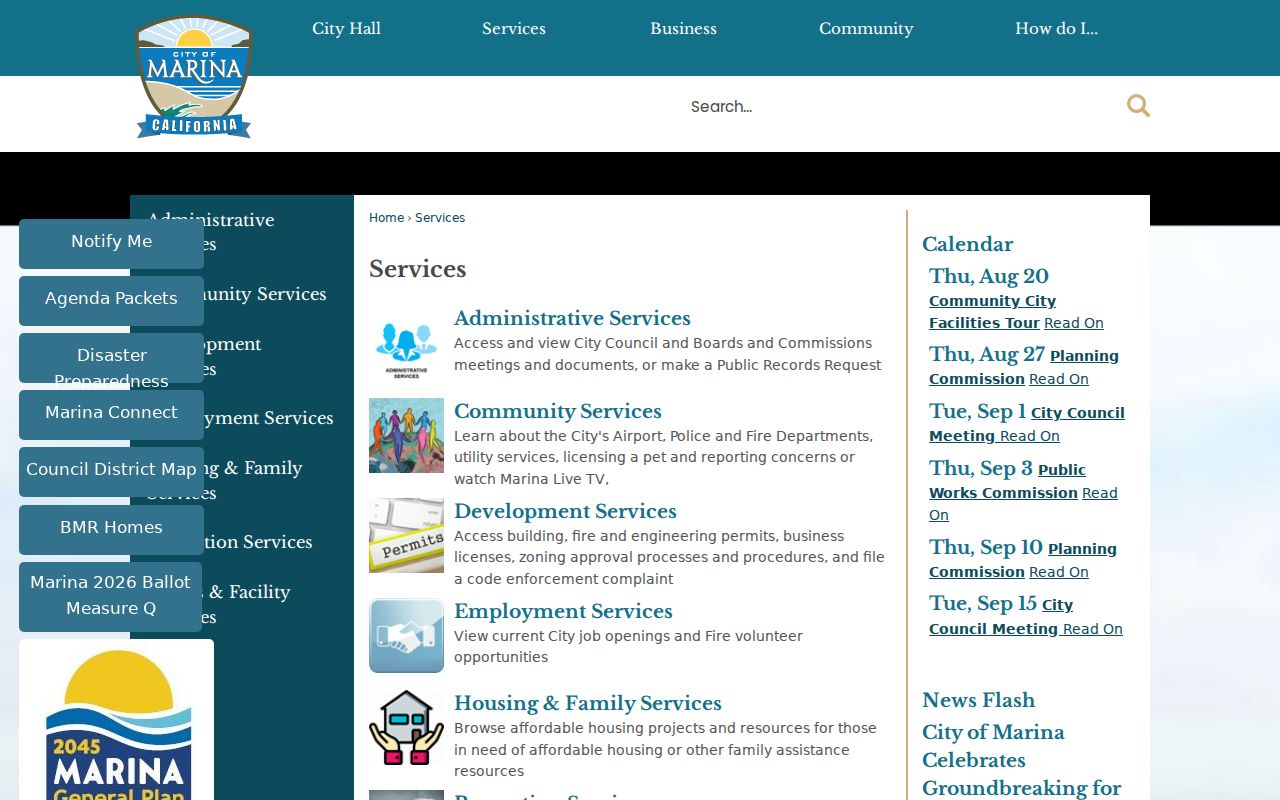
The Marina routing image is useful because it keeps a Marina search with the office that actually holds the record. A county deed request sent to City Hall, or a dispatch request sent to Marina Police, can lose time before it reaches the right custodian.
Marina Police launched its NextRequest public-records portal on March 6, 2025, as described in the city's launch notice. The portal handles city and police requests, but the notice excludes county vital records, county emergency dispatch, Superior Court files, and county property or tax records. Give a request an address or APN, department, date range, record type, and desired fields. Ask for existing entries, not a new roster.
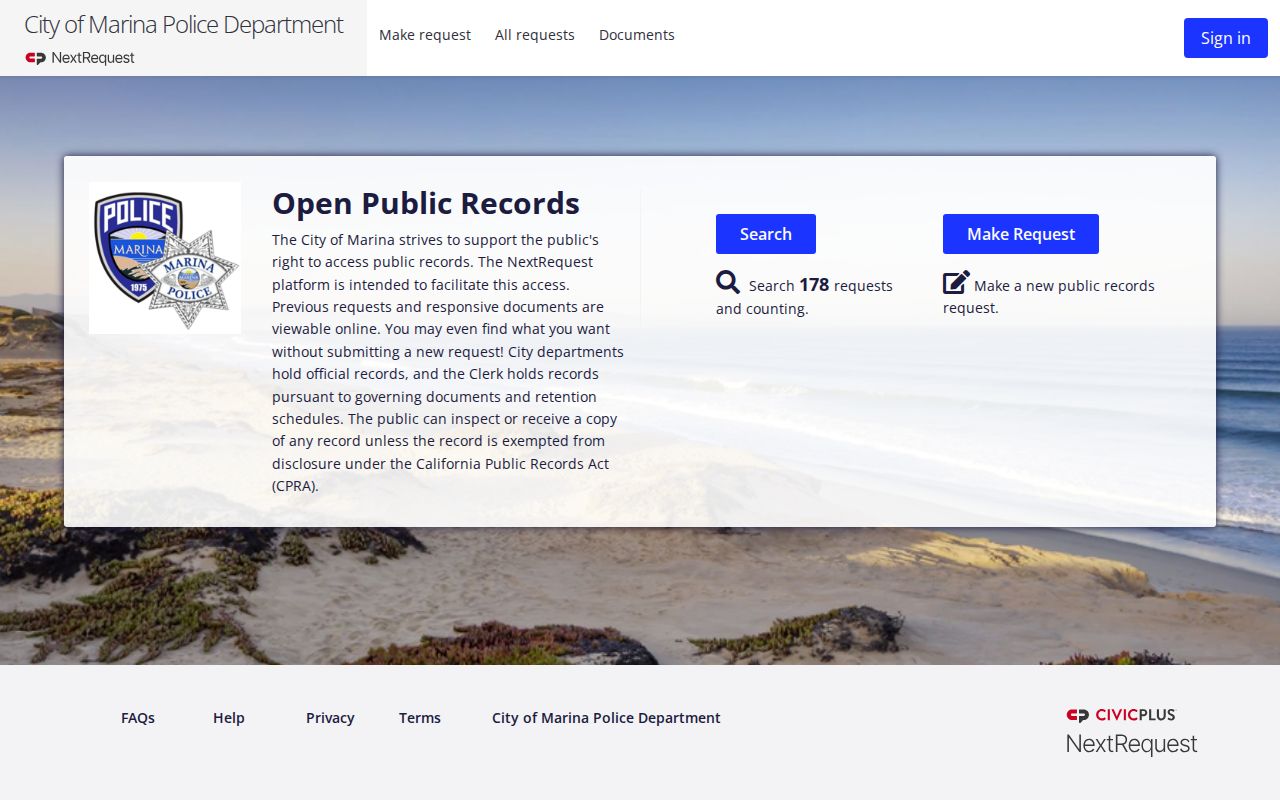
The Marina request portal image marks a timely change in access, not a new source of residents. A response may contain releasable reports, logs, or correspondence after review and redaction. When the record belongs to the county, court, or emergency communications center, the request should move to that custodian.
Marina Court Records Have Different Cutoffs
The Monterey Superior Court public portal is one of the cleanest name-based sources in a Marina workflow, but its coverage and result type need careful labeling. The Marina court describes current and completed Marina cases from 2008. Its criminal-record information separately reaches November 1992 in electronic systems. Earlier criminal indexes remain with the Salinas clerk in non-electronic form. Those dates are not one universal opening rule.
The Marina portal accepts case number, party first and last name, or business name. A case number needs at least five characters. Party searches require at least three characters for first name and four for last name. Business name searches require at least four characters. An asterisk can act as a wildcard. Results show case number, case name, case status, filing date, and case type, with ten items per page by default. No registration is required.
Online Marina results are an index or register of actions, not always the full public file. Public courthouse computers can expose additional information under California Rules of Court 2.503 and 2.507. Marina Courthouse is at 3180 Del Monte Boulevard, but criminal matters arising in Marina are processed in the Salinas Division at 240 Church Street. Confirm the Marina division before travel. The criminal clerk does not perform searches by telephone.
For a missing Marina case number, the court lists a $15 clerk search. Self-searching the portal can avoid that charge. Copies are listed at $0.50 per page, with certification and seal charges described separately. The court's civil, family, and probate route accepts counter and mail requests; criminal files can be retrieved for same-day viewing in small numbers, while larger or offsite requests can require 72 hours. Mail copy processing takes at least ten days. Juvenile, adoption, sealed, and other restricted material stays outside the ordinary search.
Note: A Marina court name match identifies a case record and date, not the identity, address, or conduct of every person with that name.
California Voter Rules for Marina Records
California's Marina voter-status tool is for an individual to check personal registration and election information. It is not a Marina name-only browse and cannot be used as an ordinary street list. The fuller Monterey County file is controlled by Elections Code sections 2188, 2194, and 18109, plus 2 CCR sections 19001-19013. Approved purposes include election, candidate, ballot-measure, political, scholarly, journalistic, and governmental work.
The Monterey County application asks for the applicant's name, organization, residence and mailing address, contact information, identification details and copy, requested geography or up to ten specific voters, desired data, purpose, delivery method, signature, and supporting documents. Vague language such as “any lawful use” is rejected. Staff normally review a Marina application in two to three business days, then quote cost. Approved data is sent by secure thumb drive or download. Sharing, unapproved reuse, harassment, marketing, and unsecured publication are prohibited.
A permitted Marina file may include name, residence and mailing address, registration status and date, party preference, precinct, districts, and participation history. Driver-license and state-ID numbers, Social Security numbers, signatures, full birth dates, and Safe at Home addresses are not a public household roster. The California Secretary of State's Safe at Home program provides eligible survivors and specified reproductive-health workers with a substitute address that can affect government records.
Lawful personal use. Marina public records can support Marina genealogy, estate work, civic research, reconnection, and careful consumer safety research. Do not use a record to stalk, harass, intimidate, dox, or publish a protected address. Elections Code section 18109 makes certain voter-data violations misdemeanors.
Historical Marina Resident Directories
Historical Marina resident directories require regional searching because the city is younger than many of the county's record series. William Locke-Paddon subdivided 1,500 acres of Pueblo Tract No. 1 in 1912. The local library began in 1916, and Marina incorporated in 1975. Earlier Marina entries may use Monterey County, Monterey, Seaside, Castroville, or Fort Ord language rather than a city title that says Marina.
Monterey County Free Libraries describes a Local History Digital Archive with more than 2,000 images and documents, chiefly from the 1890s through the 1970s. Physical photographs, pamphlets, papers, and maps are held by appointment at the MCFL Administrative Office in Marina. The Monterey Public Library California History Room provides a regional method for Marina directories, maps, great registers, census material, and archival catalogs. Exact publisher and year runs that include Marina remain unverified, so no invented volume list belongs in the local collection.
Seaside Branch microfilm of the Monterey County Herald and Salinas Californian can supply a Marina obituary or community notice. A newspaper entry may connect relatives, a maiden name, a date, or a former place, but it remains family- or publication-supplied evidence. A directory page can place a listed adult at a Marina address during its publication cycle. Deeds show a title transfer. Census schedules enumerate a household on a specific day. Keep those verbs separate.
Marina's Archive Beside the Branch Library
Marina's local-history access is unusually distributed. The Marina Branch is at 190 Seaside Circle and provides public computers, scanning, copying, faxing, printing, newspapers, and staff referral. Current listed hours are Tuesday and Wednesday 11 a.m. to 7 p.m., Thursday 10 a.m. to 6 p.m., and Friday and Saturday 10 a.m. to 5 p.m. The adjacent MCFL Administrative Office at 188 Seaside Circle holds historical photographs, pamphlets, papers, and maps by appointment through (831) 883-7512 or KrajeskiJ@countyofmonterey.gov.
The Marina physical archive's location beside the branch is a useful local-history fact, but it does not mean every Marina directory is on the branch shelf. MCFL's approximately 3,000-volume Californiana reference collection is at Prunedale and is noncirculating by appointment. Seaside holds the Marina newspaper microfilm and offers obituary searches for $5 per name. Route the request before visiting, and ask for a Marina holdings statement rather than assuming a title is present.
The Marina archive's broader story includes county daily life, farm labor camps, wartime letters, and community photographs. The Online Archive of California finding aid supplies collection-level context. It is a way to understand what an archival collection contains, not proof that a particular Marina person appears in it.
From Fort Ord to Marina City Hall
Marina's records geography has several layers. The 2020 census counted 22,359 residents, but a census number is not a current directory. Fort Ord history brings federal military sources into a land story that may later move through county deeds, Marina planning files, and California State University Monterey Bay collections. The post-base landscape added new Marina parcels, names, and institutional records. A modern Marina address can therefore point to more than one custodian over time.
City limits, postal city, and Marina record custody are different tests. A mailing line that says Marina, California does not by itself prove that City of Marina permits or police records apply. County GIS and the relevant zoning map help determine jurisdiction. A parcel's tax-mailing address can also lie elsewhere. Use the physical parcel for land questions, the city boundary for municipal questions, and the historical place name used by the record when researching an earlier Marina era.
Locke-Paddon's subdivision, the 1916 library, 1975 incorporation, Fort Ord redevelopment, and CSUMB form a practical Marina timeline for name variants. Search “Marina” alongside Monterey County, Fort Ord, Seaside, Monterey Peninsula, and Marina institutional terms when the record predates incorporation. The right result may be in a county, federal, university, library, or city collection rather than under one neat municipal label.
CPRA Requests for Marina Records
The California Public Records Act, Government Code sections 7920.000 et seq., gives any person a Marina route to inspect or request copies of identifiable existing Marina records from state and local agencies. An agency normally makes a disclosure determination within ten days and can extend that determination by fourteen days for unusual circumstances. The determination deadline is not always the production date. Agencies can charge direct-copy costs and must provide reasonably segregable nonexempt portions when the law requires it.
Marina City records can be routed through City services or NextRequest. A county request should name the assessor, recorder, elections office, or other custodian. A useful Marina request describes a field set, address or APN, date range, department, and preferred electronic format. For example, ask for existing permit index entries with permit number, application date, permit type, status, and final date. Do not ask an agency to build a resident list from scattered files.
- Identify the Marina record family and the office that legally holds it.
- State the Marina address, APN, case number, document number, person, or inclusive date range that narrows the request.
- Ask for existing Marina records and electronic fields, with segregable nonexempt portions.
- Keep the Marina request, response, redactions, and custodian explanation together with the research notes.
- If the Marina office is wrong, ask for the proper custodian instead of broadening the request into a new directory.
The California public-records FAQ describes Marina requester rights, deadlines, extensions, and fees. CPRA does not open sealed court files, confidential voter fields, protected addresses, juvenile material, adoption files, or every private detail in a Marina permit packet.
What a Marina Record Can Prove
A trustworthy Marina residents directory uses evidence verbs. A Marina index hit means the portal returned a name. A Marina address association means a dated record named a person or entity in a role. Ownership needs deed or assessment context. “Lived” should be reserved for a directory or census snapshot with a date and corroboration. “Currently lives” is rarely supportable from the public sources described here. A court complaint contains allegations. A booking is not a conviction. An obituary is family-supplied. A license address may be a business or mailing location.
- Roll
- A tax or registration list maintained for a defined administrative purpose. It is not automatically a resident list.
- Index
- A finding aid that points to a record by name, date, number, or type. An index entry is not the full image or file.
- Parcel
- A mapped unit of land identified by an APN and legal description. It is a stable land key, not a household count.
- Criss-cross directory
- A reverse directory arranged by street and number, useful for a dated listed-occupant snapshot when a verified volume includes the area.
Official records and commercial compilations also have different proof scales. A commercial people-finder product may combine public and private data, repeat old addresses, or merge people with similar names. It can be a lead to verify, never a substitute for the custodian's dated record. Official sources can be slower or restricted, but they expose the record type and the office responsible for correction.
| Question | Official custodian trail | Commercial compilation |
|---|---|---|
| What anchors Marina identity? | APN, case number, document number, entity number, license number, or dated directory entry | Often a name and an assembled address history |
| What can be checked? | Marina source office, record date, party role, legal description, status, and correction route | Underlying sources may be unclear or stale |
| What remains missing? | Unlisted occupants, protected addresses, sealed files, and restricted voter fields | May imply more certainty than the Marina public record supports |
| Best lawful use | Marina genealogy, estate work, civic research, reconnection, and parcel or record verification | Only a lead that must be checked with an official custodian |
Marina's strongest directory practice is therefore modest and specific: follow the Marina key, name the Marina custodian, record the date, compare an independent source, and stop when the law or the evidence sets a boundary.