
Marina Resident Lookup Starts With Records
No single government residents directory covers Marina. A useful Marina resident lookup follows the question to whichever office keeps the record. A parcel clue leads to Monterey County GIS. The Assessor keeps those rolls. A dated transfer belongs to the Assessor-County Clerk-Recorder index, while a name might point to the Monterey Superior Court portal, a vital-record custodian, a business filing, or a professional license. Each source confirms a different fact. An assessed owner is not automatically a current resident, and an indexed party is not automatically the person you seek.
| Record | What It Confirms | Where to Search | Access |
|---|---|---|---|
| Marina parcel and assessment roll | APN, assessed owner, situs, mailing route, values | Monterey County GIS and Assessor inquiry | Marina APN or assessment number |
| Marina recorded documents | Dated party role, transfer, lien, legal description | County official-records indexes | Index online; Marina copies by office |
| Marina court case | Case number, status, filing date, type, party match | Monterey Superior Court portal | Public index plus Marina counter or mail |
| Marina vital record | Event, family link, certificate type | California CDPH Vital Records or county custodian | Eligibility and copy rules apply to Marina events |
| Marina voter registration | One person's status or approved civic geography | California voter-status tool | Self-check or restricted application |
| Marina business or license filing | Entity, license status, public business address | SOS bizfile or DCA License Search | Public fields vary by board |
Match each source to the fact. A name alone points to indexed parties and stable numbers first. A Marina address calls for the parcel before anything else. Family questions need vital, probate, obituary, and archive routes. Do not force a modern roll to answer a historical question. A Marina resident lookup grows stronger this way. Two records should agree on date, role, and place.
Marina Court Fields for Resident Lookup
For a name-based Marina resident lookup, the Monterey Superior Court public portal stands out. It is the sharpest tool available. It offers three search modes. You can search by case number. You can also search by a party's first and last name or by a business name. The narrow rules cut down broad matches. A returned Marina name still needs identity control. No registration is required. Results form an index of Marina court actions rather than a complete public file.
The court's live search page states the minimum input for each mode. Add an asterisk when a wildcard helps. Save the Marina case number before leaving the result screen. That number is your bridge to a docket. It also opens a register of actions or a copy request.
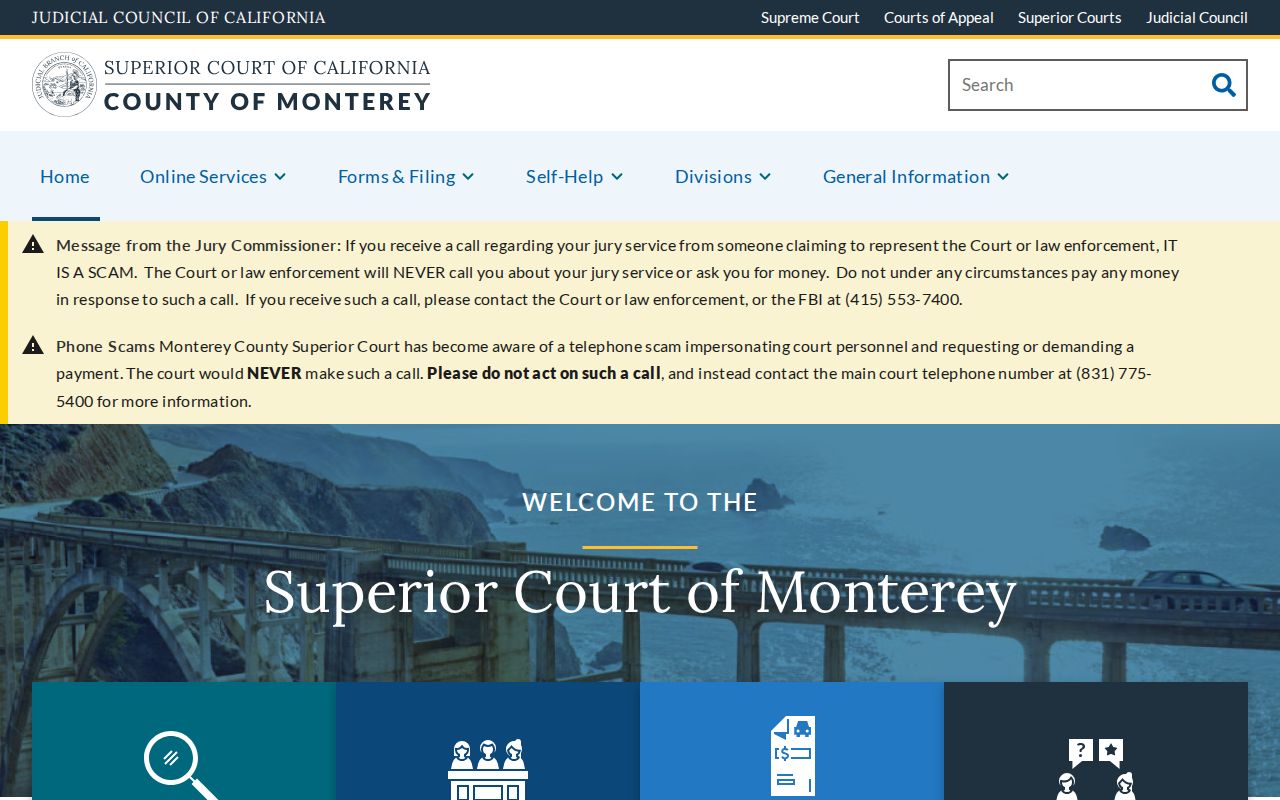
The Monterey Superior Court public case portal shows the Marina search surface. That surface is the one used for a name-based lookup.
A Marina court index is not a people directory. The image makes that gap plain. Record the case number, case name, status, filing date, and case type, then verify the Marina party role and date before concluding anything.
| Search field | Rule |
|---|---|
| Marina Case Number | At least 5 characters; add * for a wildcard. |
| Marina First Name | At least 3 characters in party mode; wildcard allowed. |
| Marina Last Name | At least 4 characters in party mode; wildcard allowed. |
| Marina Business Name | At least 4 characters; wildcard allowed. |
Marina results use five columns: Case Number, Case Name, Case Status, Filing Date, and Case Type, with ten items per page by default. A same-name result is a lead, not proof. Compare the Marina party role, record era, spelling, and any lawful identifying detail visible in the file. Only the file can settle identity.
From Marina Court Index to Records
The Monterey portal's general cases reach back to 2008. Criminal coverage runs deeper. Electronic criminal information there starts with November 1992. The criminal records page describes that range, and anything earlier is handled through the Salinas clerk rather than a single statewide trial-court search. The Marina Courthouse at 3180 Del Monte Boulevard is a local contact point. Marina criminal cases are processed in the Salinas Division at 240 Church Street. Other calendars may involve Monterey Courthouse, 1200 Aguajito Road. Keep the Marina division in the request notes. The Marina court case-search instructions explain the online starting point and help separate a public index from the underlying file.
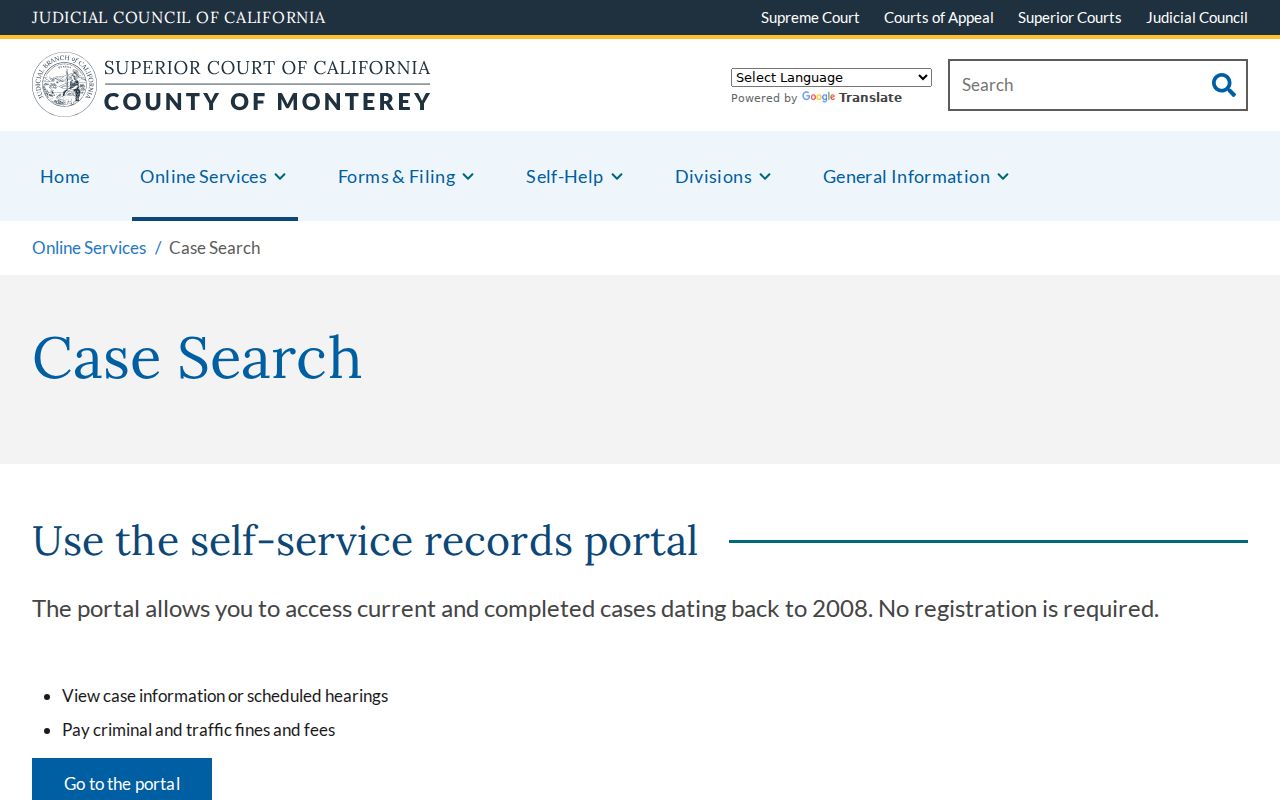
The case number controls the next request. Public courthouse computers open Marina calendars, registers of action, and additional case information. Onsite, the clerk can retrieve up to three criminal files for same-day viewing. More than three takes longer. An offsite file may too, since either can require 72 hours.
The civil, family, and probate records office explains Marina copy and certification routes. Fees follow a set schedule. A clerk search without a case number costs $15, and copies run $0.50 per page. Certification with a seal adds $25 per document. Copies are charged on top. The civil, family, and probate certification category is listed separately at $15 per document, subject to the current schedule and dissolution exceptions.
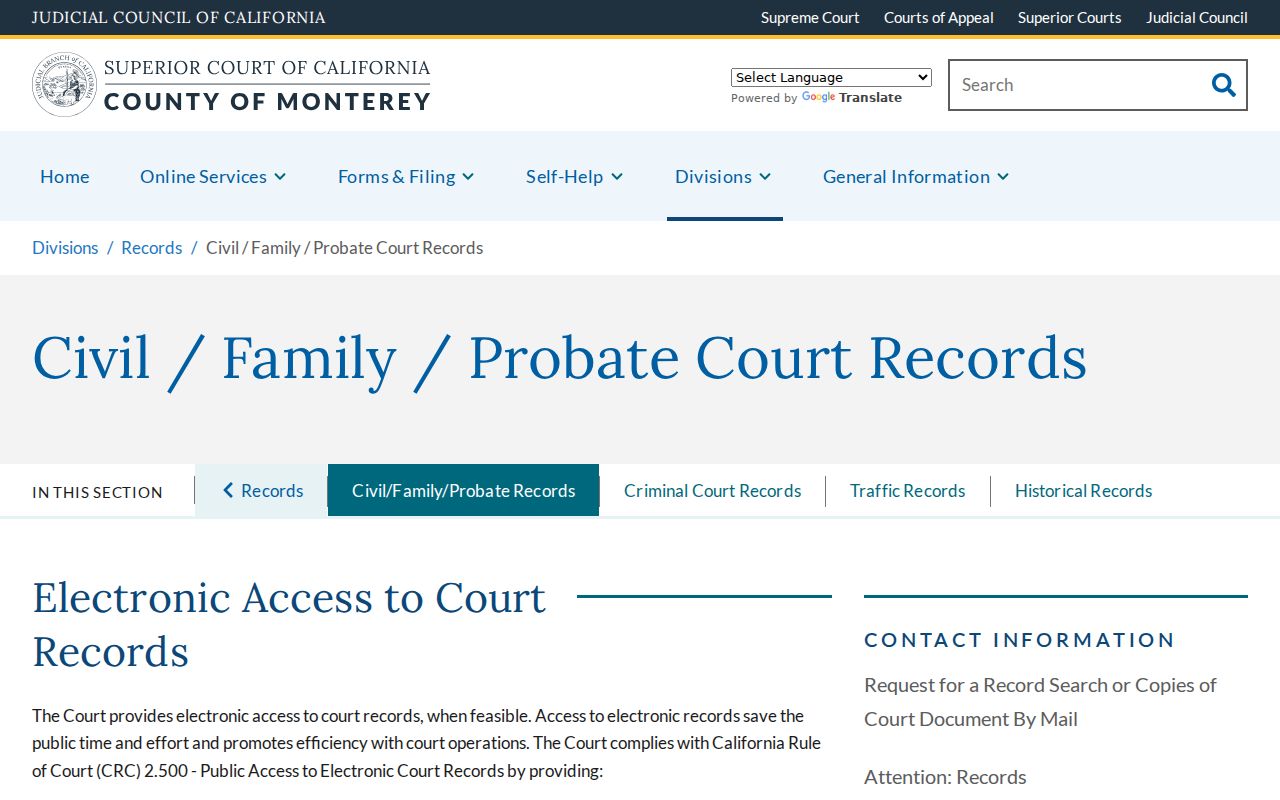
The criminal records office handles Marina criminal records. It performs no searches by telephone. Marina mail requests need the official form, identifying details, a check or money order, and a self-addressed stamped envelope. Copy processing takes at least ten days.
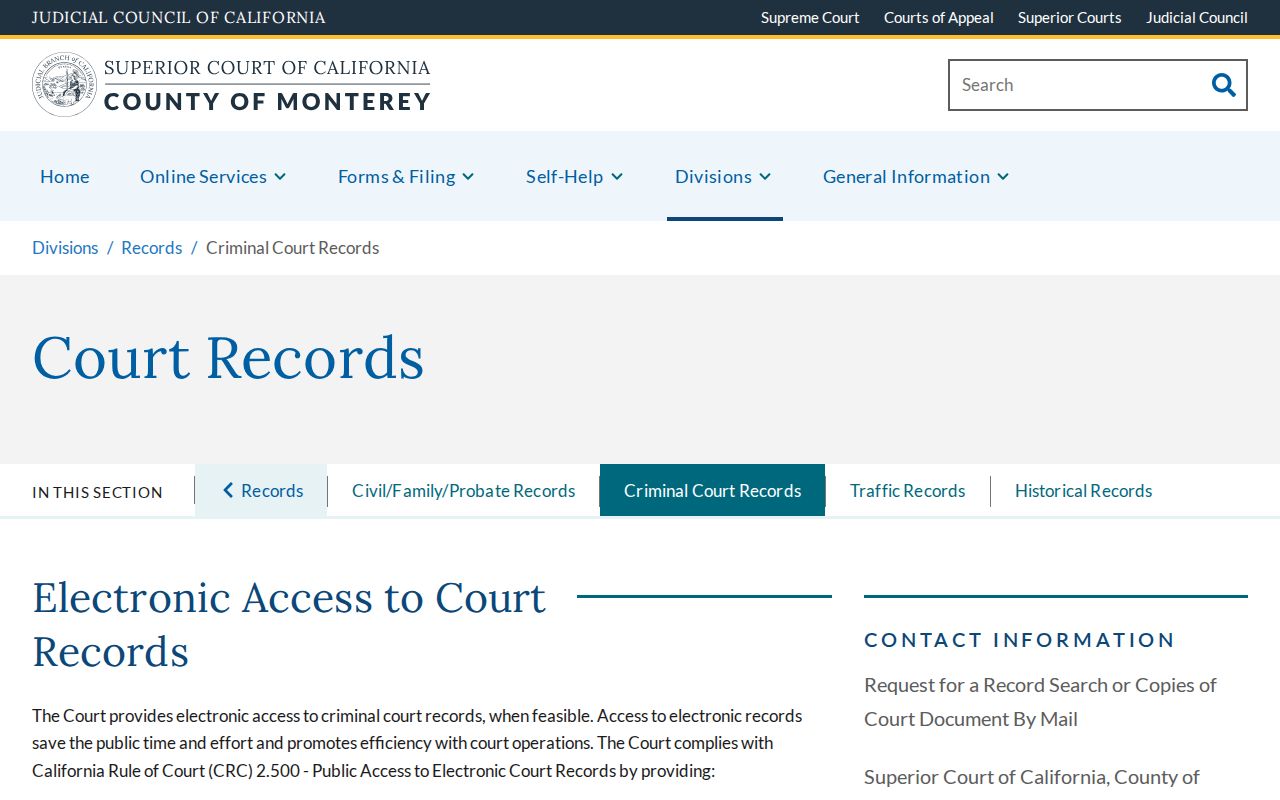
The Marina criminal-record image carries one key distinction. A docket entry may show an allegation, a filing, or a disposition. A booking is not a conviction. Compare the case type and status. Never describe a Marina party beyond what the public record supports. The Monterey Superior Court locations page supplies the Marina court-wide contact map before a trip.
Check the Marina division listed in the locations image before you request any file. Asking the wrong branch wastes a trip. Keep two limits in mind as well: juvenile and adoption matters stay confidential, sealed records cannot be released, and remote access to family or criminal cases can be narrower than what you would find at the courthouse itself.
Note: A Marina public portal match supplies a case lead, not a certified identity or a complete file.
Marina Name Anchors for Resident Lookup
A name is where a Marina resident lookup starts, never where it ends. Treat every hit as a lead. Search spelling variants, initials, and shortened first names. Try trust and entity names and likely county variations before trusting anything. Then hold the match to at least two anchors: a dated address, a party role, an APN. A spouse or relative named in a historical source can also anchor it, as can a case type, an entity number, or a license number. A Marina city match on its own proves far too little.
Use evidence verbs with care. An index lists a name. A deed identifies a dated party plus a legal description. An assessor roll identifies an assessed owner. A permit names an applicant or owner tied to a project. A directory lists an adult at a publication date. A court complaint contains only allegations. Keeping these verbs straight matters. It stops a weak association from hardening into a claim of current residence in the Marina residents directory.
- Normalize the Marina name and write down every spelling or initial variation before searching.
- Choose one stable Marina record number, APN, license number, or entity number when the first result supplies it.
- Compare the time, role, and place in a second independent Marina custodian's record.
- Stop when Marina records are sealed, protected, or too thin to distinguish two people.
A Marina clerk cannot confirm identity over the phone. That is simply not the job. Ask instead which index exists and how to inspect or order the file, a far better path than pressing staff to vouch for a person from a loose name.
Verifying a Marina Resident Record
The strongest Marina one-person workflow starts with a broad clue. It ends at the underlying document. Check any Marina address in Monterey County GIS rather than trusting a mailing line. The APN opens several doors. Those doors include an assessor result, a recorder party search, or a Marina permit file. A name-first search works too. Court, business, and professional indexes all hold leads. Whatever surfaces, date the record. Assign the person a role before you rely on it.
- Write the Marina name, known place, date range, and reason for the search in a private research note.
- Use Marina GIS or a public filing to anchor the clue to a parcel, case, entity, or license number.
- Search the matching Marina custodian and save the exact result fields, including status and date.
- Order an official Marina copy only when the underlying document is needed for an estate, family, civic, or personal record.
- Correct an error with the Marina office that holds the record rather than repeating an unverified match.
- Marina docket
- A court's running record of filings, hearings, orders, and case events.
- Marina index versus image
- An index is a finding aid with names and key fields; an image is the scanned or filed record itself.
- Marina certified copy
- A copy that the custodian attests is a true record, often needed when an official recipient will not accept an ordinary copy.
That index-to-image step is where a Marina name search proves itself. The Marina portal may display a case number. The clerk or records counter holds the actual file. The assessor shows parcel facts, but the recorder controls the deed image. A public result works as evidence only while its limits stay attached.
Marina Vital Records for Resident Lookup
Vital records answer an event question, not a live-address question. Keep that distinction first. For a Marina event, the Monterey County Recorder issues Marina birth and death certificates for all years. It also handles public marriages performed in the county. The county health local registrar covers the current and preceding year for births and deaths. The County Clerk handles confidential marriages. The Superior Court holds the actual divorce decree. CDPH supplies the statewide route whenever custody for a Marina event is unclear.
California splits certified copies into two types. The split falls under Health and Safety Code sections 103525 and 103526. An authorized Marina birth or death copy demands a qualifying relationship and, by mail, a notarized sworn statement. An informational copy is generally open to the public. But it carries a legend and cannot establish identity. Confidential-marriage access stays narrower under Family Code section 511. Adoption and juvenile files remain confidential.
| Record | Custodian route | January 1, 2026 fee |
|---|---|---|
| Marina birth certificate | CDPH VS 111 or county recorder | $31 |
| Marina death certificate | CDPH VS 112 or county recorder | $26 |
| Marina public marriage certificate | CDPH VS 113A or Monterey County recorder for a Marina event | $19 |
| Marina dissolution certificate | CDPH VS 113B; decree comes from court | $18 |
CDPH treats the fee as a search fee and keeps it even when no record turns up, issuing a Certificate of No Public Record instead. Check the current vital-record fee schedule before mailing a Marina order. The county custodian guide helps route a local request to the right office. Forms ask for the event place and date, names, relationship or eligibility, contact details, a signature, and sometimes a notary block. For a Marina family inquiry, pair a lawful certificate request with probate, obituary, or historical sources rather than treating a public index as a finished family tree.
Note: CDPH retains the search fee when no record is found, so confirm the correct Marina custodian before ordering.
Heirs, Classmates, Birth-Family Routes
A humane Marina identity search can answer a focused family or reconnection question without overreaching. For an heir, begin with an obituary and a probate case. Then look for recorded distribution deeds. Probate names a petitioner, a decedent, hearings, and filed instruments. A deed shows how an estate transfer reached a parcel. Neither source should become a permanent list of living relatives.
Former classmates are better found through yearbooks, school collections, and alumni materials. The Marina-area library network helps too. The Marina Branch offers public computers, scanning, copies, and newspapers. It also gives referrals to Monterey County resources serving Marina. The MCFL physical archive at 188 Seaside Circle holds historical photographs, papers, pamphlets, and maps by appointment. The California History Room provides regional genealogy and house-history guidance.
Birth-family research must travel California's official adoption-information routes. These run through the responsible state, county, or court program with mutual consent. Sealed adoption records are not an invitation to bypass the rules. A good result respects the person who never appears in a public index.
- Use Marina probate and distribution deeds for an estate trail.
- Use Marina-area yearbooks and library collections for a classmate trail.
- Use official mutual-consent programs for Marina birth-family questions.
- Use Marina newspapers and obituaries as leads, then verify dates with the custodian.
For Marina newspaper help, the Seaside Branch holds Monterey County Herald and Salinas Californian microfilm and runs obituary searches for $5 per name. That service can connect relatives and dates. Just do not treat a secondary notice as a certified fact.
Business Filings Are Not Home Proof
California's Secretary of State runs the bizfile system. It handles the cases where a Marina name actually belongs to an entity. A corporation, LLC, limited partnership, or nonprofit can be pulled up in two ways. Search by entity name or file number. Advanced filters narrow results by entity type, status, and initial filing date. More than 17 million documents sit in the archive. That includes recent Statements of Information, all free as PDFs. One limit: basic results stop at the 500 closest matches. LLPs and general partnerships fall outside the normal search entirely. Those require a paper records order instead.
The California SOS business search yields a Marina entity number and filing status. It also returns the agent for service, plus managers or officers where disclosure applies. Public business addresses come through the same lookup. Treat all of it as business evidence, not proof of a residence.
The Marina business-record image explains the caution. A registered agent or mailing address might be a commercial suite, a service address, or another person's address entirely. Entity paperwork never establishes that an individual lives at a given spot in Marina. That is a records question, not a business question.
Professional licensing offers a separate lawful identity check. The California Department of Consumer Affairs license search, the State Bar search, and the Contractors State License Board search can each return a licensee's name, number, status, dates, public address, and discipline links when a board publishes them. These Marina fields help separate people who share a name. They should not be stretched to infer anyone's private home. City-level Marina planning, building, and local business-license records add one more angle, since an applicant or responsible party may be named on a dated project.
Marina Resident Lookup Privacy Limits
California's voter file is not an open Marina street directory. The Secretary of State's self-check exists so an individual can review their own registration. Anyone else goes through Monterey County Elections, and the requirements are strict. The application needs an original signature and a copy of government ID. It also requires a precise geography or up to ten named voters, and an approved purpose such as election, scholarly, journalistic, political, or governmental use. Staff typically need two to three business days before quoting a cost. Commercial use, marketing, harassment, unapproved transfer, and unsecured publication are all barred.
Safe at Home gives an eligible survivor or a covered reproductive-health worker a substitute address. That address shields the residence across Marina voter and other government records. Others stay hidden too. That includes protected officials, minors, victims, utility customers, and anyone in sealed or confidential files. The California Public Records Act lets a requester ask for identifiable existing records. It is Government Code sections 7920.000 and following. It never forces an office to build a fresh Marina residents list.
A wrong Marina result calls for a correction with the right custodian. The assessor owns parcel facts. The recorder handles index and corrective-instrument questions. The court clerk handles docket issues. The SOS or a licensing board takes filing errors. Elections fixes registration, while CDPH or the county handles vital records. A Marina resident lookup should simply stop when the evidence is protected or sealed. Thin evidence cannot support a responsible conclusion either.
Lawful use. Use a Marina resident lookup for personal, genealogical, estate, civic, or safety research. California Penal Code section 646.9 and civil-harassment remedies make stalking, threats, intimidation, and harassment unlawful.